Thursday, July 16, 2020

Architectural Eyelashes

“Perhaps if the future existed, concretely and individually, as something that could be discerned by a better brain, the past would not be so seductive: its demands would be balanced by those of the future. Persons might then straddle the middle stretch of the seesaw when considering this or that object. It might be fun. But the future has no such reality (as the pictured past and the perceived present possess); the future is but a figure of speech, a specter of thought.”     
                                                                              Transparent Things, Vladimir Nabokov

 
I miss having a front porch. My parents’ house had a porch deep enough to hide from the summer sun or driving rain, but open enough to wave to passers-by. Its painted wood floor sat four steps up from the front walk, which stretched about 50 feet from the tree-lined sidewalk. A leisurely pace up the walk gave you time to put your glass down and prepare to greet a visitor. The two of you might stand there--you on the porch, they on the bottom step--to exchange a bit of news. Or they might commit to a proper visit, and make the four-step climb to join you in a glass of wine. There you could linger, neither completely inside nor completely outside, but between the two, in a space designed for just that purpose. The front porch is a liminal space.

A liminal space is a threshold or passage between two conditions, each of which seems distinct once you’re in them looking back at the boundary. Liminal spaces signal difference, with all the political freight that burdens that word, because certain things belong on one side or the other of the between. It’s tempting to say that a liminal space is neither here nor there, but there actually is a there there. It is architecture’s responsibility to provide a place in the between, to amplify and adorn the passage. That’s what stoops, porches, balconies, and bay windows do. They’re like architectural eyelashes, filtering the people and particles that pass between public and private, welcome and unwelcome. Public facing—unlike back yards and decks--they open or close you to the world, screen intruders, admit air, allow observation without being observed, and they get dressed up for holidays. They wink and blink, animating the building’s façade—literally, its face--broadcasting a steady stream of wordless communication to any onlooker. Eyelash spaces are a mark of architectural generosity, the gift of liminality that bestows the freedom to engage with the world on our terms. Watch the parade from your bay window; wave at the world from your porch; drink coffee on your stoop; bang pots and pans in protest from your balcony. In a Covid-threatened world, we desperately need places like these where we can engage with others over distance, to breathe apart together. They are the only architectural elements that can flirt, that can spark delight in the absent-minded passer-by. 

Architecture makes something magical about dwelling in the liminal, on the porch between sidewalk and living room. By providing these places, these architectural lashes, we also provide time: places to be between tasks, before and after, to step out on the balcony, away from the screen. Vladimir Nabokov’s opens his novella Transparent Things suggesting that the present itself is liminal, and if we could just see the concreteness of the zones—past and future-- to either temporal side of us, we “might then straddle the middle stretch of the seesaw when considering this or that object. It might be fun.” Yes, fun. We can design much better places than seesaws to straddle this middle stretch, between a past fading to lo-res nostalgia, and a future that has never seemed more uncertain. In the coming redesign of the world, let’s not forget the subtle social significance of a little fringe of lashes on our buildings’ faces.

Tuesday, June 2, 2020

Right to the City


I can only remember a handful of jokes in sufficient detail to get a laugh. (Did you hear the one about the photon checking into a hotel?) One of my favorites is about a boy who didn’t speak. The parents were so excited to welcome their beautiful baby boy, and as he grew he met or exceeded every measurement—height, weight, responsiveness,--except for speech. Don’t worry, said the doctor, boys don’t speak as early as girls. The boy entered kindergarten, then first grade, then second, still silent. Don’t worry, said the teachers, he’s managing fine. He did well in school, was cheerful, and beloved by his more loquacious classmates, so by and by the parents accepted him as he was. Then one morning, just weeks before he was to leave for college, he said, “Mom, the toast is burning.” His parents looked at him in astonishment—a miracle! He speaks! “Son,” they said almost in unison, “all this time you haven’t said a word. Why now?” “Until now,” he answered, “everything was fine.”

Until now, everything was fine. We didn’t need to speak up. Now we ask when can we get back to normal? We ask because until now everything was fine. When can I get my hair cut? Eat at a restaurant? Go to a baseball game? Take public transportation? Get my nails done? Hang out on the stoop with my friends? Go bird-watching in the park? Walk down the street without being shot? Oh, sorry…This was supposed to be about Covid-19 and, you know, getting back to normal. Until that happened, everything was fine. Now it’s burning.

In Rebel Cities: from the Right to the City to the Urban Revolution, David Harvey writes about the successive spasmodic expansions and narrowing of access to the benefits—spatial, political, social, cultural, and economic—of the city throughout history. He cautions, though, that we not romanticize some ideal state when there was such a thing as an a priori “city” independent of the heterogeneous actors who continually shape it. When we repeat the wish to get “back to normal” we fall into that trap—that somehow, until now, everything was fine, that there was a “normal.” When we envision that “normal” city as a sequence of leisure spaces designed for consumption by people of means, when we design public spaces without access to water, seating, and restrooms to anyone but paying customers, when we estheticize one population and criminalize others, when we fail to maintain public infrastructure, when we mistake our own experience for a universal one, we expose the limits of the lenses through which we have been looking. It was easy to stay silent as long as everything seemed fine to me.

The city, such as it is, is under constant construction—literal, physical, social, and cultural construction. It is assembled by each of its inhabitants—each of them—and the right to that city belongs to all. We shouldn’t be looking to getting back to normal but to making a better normal: an equitable, diverse, green, healthy city to which we are all entitled. Everything wasn't fine.

Thursday, May 28, 2020

Yes, and...


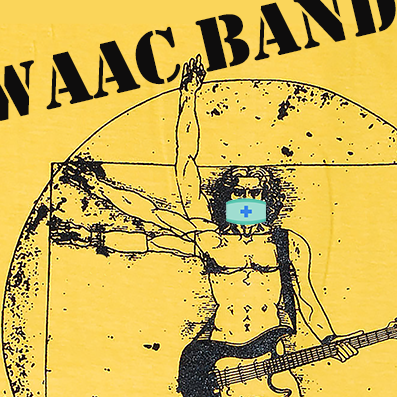
The semester ended not with a cymbal crash, but with a feeble “end meeting for all?” prompt from Zoom. We tried to make the celebration as celebratory as the medium would allow, but with no buffet from Bittersweet, no one pouring Trader Joe’s best, no mixing and mingling of students, faculty, staff, alumni, and friends in the rooms and hallways of 1001 Prince among a year’s creative production, it just wasn’t the same. Mostly, I missed the Band. The WAAC Band plays for all the WAAC's parties and we’re ready and open for anyone to sit in. Whatever we practiced, whatever we thought the set list would be, the night never quite goes that way. And it’s wonderful. There is nothing quite like the feeling of getting into a groove-- blues in E—when you know enough about where the song might go, but not so much that you can’t be surprised in the moment. I miss that. For all the interesting new powers that Zoom and its cousins have provided, there is suite of joys they cannot: serendipity, chance, improvisation.

The WAAC Band is constantly changing personnel, adjusting to circumstance as students and faculty come and go. What we lack in precision, though, we make up for in enthusiasm. Sometimes we have cello player; sometimes a banjo. This past year we had an exchange student from Japan who played trombone. So, we made space in every song for a trombone solo. We never really know who will show up, but someone always does.

It happens every semester: we’ll set up and start to practice in the library (Great acoustics. Who woulda thought?) and a new student will poke their head in with that look, a combination of longing and hesitancy. (Admittedly, there are other looks-- the “what the heck is going on in here? look” Or the “how do I get past the drummer to get to the Reserve Shelf?” look) I’ll ask if they play or sing, and the answer is often yes, I play violin/piano/guitar/drums/whatever… Then I have to ask the follow up questions: Does the phrase “blues in E mean anything to you?” If the answer is a knowing smile and a yes, then odds are the answer to the next question will be “no” because the next question is: do you need notes? You know--music. Written on a staff. 

In my experience, there seems to be a correlation between knowing the blues scale and not needing notes, but it’s not necessarily constant. I know notes; but I don't need them. I learned how to read music when I learned how to play piano, but I was lucky to learn something else: theory. I didn’t know then that I was learning theory. That’s not surprising: I was in middle school, and I didn’t know much of anything. (although that’s not what I would have told you at the time.) My unconventional, to say the least, piano teacher would hand me a song with just lyrics and the names of chords where the changes were. She would hum the melody and tap out the rhythm, suggest a left hand pattern, and then tell me to play it. If I could do that, I could play anything. I learned to regard written music the way I now see recipes, as a set of suggestions rather than orders. As long as you understand the end goal, can see the field, there’s room for interpretation. For improvisation. 

Theory bestows the power to improvise, not merely to react to the situation. Actors will tell you that the first rule of “improv” is that the answer to any prompt is “yes, and…” Improv is a technique of performance, a jujitsu of accepting challenges, a reflecting-in-action, as we design-types might say, but at blink speed. In that sense, it may seem to be the exact opposite of Le Corbusier’s “studio of patient research” or the methodical retreat of a scholar’s study, or any other model of deliberate studiousness. Yet improv demands thoughtfulness in equal measure to quickness. It is resourceful; like a trickster making use only of the materials at hand. It is attentive and imaginative by necessity. Improv is creativity on deadline. It’s design.

It’s hard to maintain the improvisationalist’s balance these days because the prompts are dark and uncertain. For design, however, and those who practice it in any form at any scale, there’s no option to refuse the prompt. We have to answer, yes, and… Because, as singer/songwriter Paul Brady reminds us, the world is what we make it.